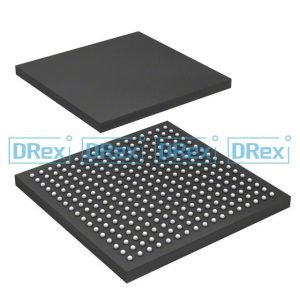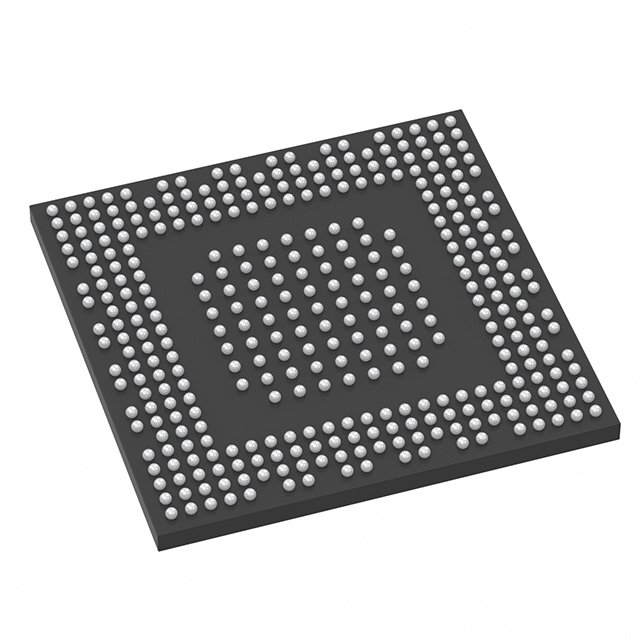
STM32MP157CAC3
MPU supporting embedded Linux platforms.
Product Description
The STM32MP157C/F devices are based on the high-performance dual-core Arm® Cortex®-A7 32-bit RISC core operating at up to 800 MHz. The Cortex-A7 processor includes a 32-Kbyte L1 instruction cache for each CPU, a 32-Kbyte L1 data cache for each CPU and a 256-Kbyte level2 cache. The Cortex-A7 processor is a very energy-efficient application processor designed to provide rich performance in high-end wearables, and other low-power embedded and consumer applications. It provides up to 20% more single thread performance than the Cortex-A5 and provides similar performance than the CortexA9.
The Cortex-A7 incorporates all features of the high-performance Cortex-A15 and CortexA17 processors, including virtualization support in hardware, NEON™, and 128-bit AMBA®4
AXI bus interface. The STM32MP157C/F devices also embed a Cortex® -M4 32-bit RISC core operating at up to 209 MHz frequency. Cortex-M4 core features a floating point unit (FPU) single precision which supports Arm® single-precision data-processing instructions and data types. The Cortex® -M4 supports a full set of DSP instructions and a memory protection unit (MPU)
which enhances application security. The STM32MP157C/F devices also embed a 3D graphic processing unit (Vivante® – OpenGL® ES 2.0) running at up to 533 MHz, with performances up to 26 Mtriangle/s, 133 Mpixel/s. The STM32MP157C/F devices provide an external SDRAM interface supporting external memories up to 8-Gbit density (1 Gbyte), 16 or 32-bit LPDDR2/LPDDR3 or DDR3/DDR3L up to 533 MHz. The STM32MP157C/F devices incorporate high-speed embedded memories with 708 Kbytes of Internal SRAM (including 256 Kbytes of AXI SYSRAM, 3 banks of 128 Kbytes each of AHB SRAM, 64 Kbytes of AHB SRAM in backup domain and 4 Kbytes of SRAM in backup domain), as well as an extensive range of enhanced I/Os and peripherals connected to APB buses, AHB buses, a 32-bit multi-AHB bus matrix and a 64-bit multi layer AXI interconnect supporting internal and external memories access.
All the devices offer two ADCs, two DACs, a low-power RTC, 12 general-purpose 16-bit timers, two PWM timers for motor control, five low-power timers, a true random number generator (RNG), and a cryptographic acceleration cell. The devices support six digital filters for external sigma delta modulators (DFSDM). They also feature standard and advanced communication interfaces.
• Standard peripherals
– Six I2Cs
– Four USARTs and four UARTs
– Six SPIs, three I2Ss full-duplex master/slave. To achieve audio class accuracy, the
I2S peripherals can be clocked via a dedicated internal audio PLL or via an external clock to allow synchronization.
– Four SAI serial audio interfaces
– One SPDIF Rx interface
– Management data input/output slave (MDIOS)
– Three SDMMC interfaces
– An USB high-speed Host with two ports two high-speed PHYs and a USB OTG high-speed with full-speed PHY or high-speed PHY shared with second port of USB Host.
– Two FDCAN interface, including one supporting TTCAN mode
– A Gigabit Ethernet interface
– HDMI-CEC
• Advanced peripherals including
– A flexible memory control (FMC) interface
– A Quad-SPI flash memory interface
– A camera interface for CMOS sensors
– An LCD-TFT display controller
– A DSI Host interface.
Refer to Table 1: STM32MP157C/F features and peripheral counts for the list of peripherals available on each part number. A comprehensive set of power-saving mode allows the design of low power applications. The STM32MP157C/F devices are proposed in 4 packages ranging from 257 to 448 balls with pitch 0.5 mm to 0.8 mm. The set of included peripherals changes with the device chosen. These features make the STM32MP157C/F suitable for a wide range of consumer, industrial, white goods and medical applications
Key Features
Includes ST state-of-the-art patented technology
Core
• 32-bit dual-core Arm® Cortex®-A7
– L1 32-Kbyte I / 32-Kbyte D for each core
– 256-Kbyte unified level 2 cache
– Arm® NEON™ and Arm® TrustZone®
• 32-bit Arm® Cortex®-M4 with FPU/MPU
– Up to 209 MHz (Up to 703 CoreMark®)
Memories
• External DDR memory up to 1 Gbyte
– up to LPDDR2/LPDDR3-1066 16/32-bit
– up to DDR3/DDR3L-1066 16/32-bit
• 708 Kbytes of internal SRAM: 256 Kbytes of AXI SYSRAM + 384 Kbytes of AHB SRAM + 64 Kbytes of AHB SRAM in Backup domain and 4 Kbytes of SRAM in Backup domain
• Dual mode Quad-SPI memory interface
• Flexible external memory controller with up to 16-bit data bus: parallel interface to connect external ICs and SLC NAND memories with up to 8-bit ECC Security/safety
• Secure boot, TrustZone® peripherals, active tamper
• Cortex®-M4 resources isolation Reset and power management
• 1.71 V to 3.6 V I/Os supply (5 V-tolerant I/Os)
• POR, PDR, PVD and BOR
• On-chip LDOs (RETRAM, BKPSRAM, DSI 1.2 V, USB 1.8 V, 1.1 V)
• Backup regulator (~0.9 V) Internal temperature sensors
• Low-power modes: Sleep, Stop and Standby
• DDR memory retention in Standby mode
• Controls for PMIC companion chip Low-power consumption
• Total current consumption down to 2 µA (Standby mode, no RTC, no LSE, no BKPSRAM, no RETRAM)
Clock management
• Internal oscillators: 64 MHz HSI oscillator,
4 MHz CSI oscillator, 32 kHz LSI oscillator
• External oscillators: 8-48 MHz HSE oscillator, 32.768 kHz LSE oscillator
• 6 × PLLs with fractional mode General-purpose input/outputs
• Up to 176 I/O ports with interrupt capability
– Up to 8 secure I/Os
– Up to 6 Wakeup, 3 tampers, 1 active tamper
Interconnect matrix
• 2 bus matrices
– 64-bit Arm® AMBA® AXI interconnect, up to 266 MHz
– 32-bit Arm® AMBA® AHB interconnect, up to 209 MHz
3 DMA controllers to unload the CPU
• 48 physical channels in total 1 × high-speed general-purpose master direct memory access controller (MDMA)
• 2 × dual-port DMAs with FIFO and request router capabilities for optimal peripheral management
Up to 37 communication peripherals
• 6 × I2C FM+ (1 Mbit/s, SMBus/PMBus)
• 4 × UART + 4 × USART (12.5 Mbit/s, ISO7816 interface, LIN, IrDA, SPI)
• 6 × SPI (50 Mbit/s, including 3 with full duplex
I2S audio class accuracy via internal audio PLL or external clock)(+ 4 with USART)
• 4 × SAI (stereo audio: I2S, PDM, SPDIF Tx)
• SPDIF Rx with 4 inputs
• HDMI-CEC interface
• MDIO Slave interface
• 3 × SDMMC up to 8-bit (SD / e•MMC™ / SDIO)
• 2 × CAN controllers supporting CAN FD protocol, out of which one supports timetriggered CAN (TTCAN)
• 2 × USB 2.0 high-speed Host
+ 1 × USB 2.0 full-speed OTG simultaneously – or 1 × USB 2.0 high-speed Host
+ 1 × USB 2.0 high-speed OTG simultaneously
• 10/100M or Gigabit Ethernet GMAC
– IEEE 1588v2 hardware, MII/RMII/GMII/RGMII
• 8- to 14-bit camera interface up to 140 Mbyte/s 6 analog peripherals
• 2 × ADCs with 16-bit max. resolution (12 bits up to 4.5 Msps, 14 bits up to 4 Msps, 16 bits up to 3.6 Msps)
• 1 × temperature sensor
• 2 × 12-bit D/A converters (1 MHz)
• 1 × digital filters for sigma delta modulator (DFSDM) with 8 channels/6 filters
• Internal or external ADC/DAC reference VREF+ Graphics
• 3D GPU: Vivante® – OpenGL® ES 2.0
– Up to 26 Mtriangle/s, 133 Mpixel/s
• LCD-TFT controller, up to 24-bit // RGB888
– up to WXGA (1366 × 768) @60 fps or up to Full HD (1920 × 1080) @30 fps
– Pixel clock up to 90 MHz
– Two layers with programmable colour LUT
• MIPI® DSI 2 data lanes up to 1 Gbps each Up to 29 timers and 3 watchdogs
• 2 × 32-bit timers with up to 4 IC/OC/PWM or pulse counter and quadrature (incremental) encoder input
• 2 × 16-bit advanced motor control timers
• 10 × 16-bit general-purpose timers (including 2 basic timers without PWM)
• 5 × 16-bit low-power timers
• RTC with sub-second accuracy and hardware calendar
• 2 × 4 Cortex®-A7 system timers (secure, nonsecure, virtual, hypervisor)
• 1 × SysTick M4 timer
• 3 × watchdogs (2 × independent and window)
Hardware acceleration
• AES 128, 192, 256, TDES
• HASH (MD5, SHA-1, SHA224, SHA256), HMAC
• 2 × true random number generator (3 oscillators each)
• 2 × CRC calculation unit
Debug mode
• Arm® CoreSight™ trace and debug: SWD and JTAG interfaces
• 8-Kbyte embedded trace buffer 3072-bit fuses including 96-bit unique ID, up to 1184-bit available for user
All packages are ECOPACK2 compliant