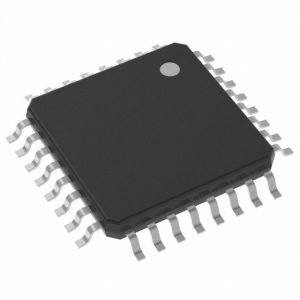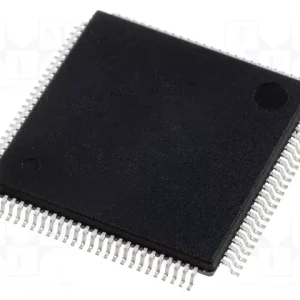
STM32H743ZIT6
High-performance MCU for real-time industrial processing.
Product Description
STM32H742xI/G and STM32H743xI/G devices are based on the high-performance Arm® Cortex®-M7 32-bit RISC core operating at up to 480 MHz. The Cortex® -M7 core features a floating point unit (FPU) which supports Arm® double-precision (IEEE 754 compliant) and single-precision data-processing instructions and data types. STM32H742xI/G and STM32H743xI/G devices support a full set of DSP instructions and a memory protection unit (MPU) to enhance application security. STM32H742xI/G and STM32H743xI/G devices incorporate high-speed embedded memories with a dual-bank flash memory of up to 2 Mbytes, up to 1 Mbyte of RAM (including 192 Kbytes of TCM RAM, up to 864 Kbytes of user SRAM and 4 Kbytes of backup SRAM), as well as an extensive range of enhanced I/Os and peripherals connected to APB buses, AHB buses, 2×32-bit multi-AHB bus matrix and a multi layer AXI interconnect supporting internal and external memory access.
All the devices offer three ADCs, two DACs, two ultra-low power comparators, a low-power RTC, a high-resolution timer, 12 general-purpose 16-bit timers, two PWM timers for motor control, five low-power timers, a true random number generator (RNG). The devices support four digital filters for external sigma-delta modulators (DFSDM). They also feature standard and advanced communication interfaces.
Standard peripherals
– Four I2Cs
– Four USARTs, four UARTs and one LPUART
– Six SPIs, three I2Ss in Half-duplex mode. To achieve audio class accuracy, the I2S peripherals can be clocked by a dedicated internal audio PLL or by an external clock to allow synchronization.
– Four SAI serial audio interfaces
– One SPDIFRX interface
– One SWPMI (Single Wire Protocol Master Interface)
– Management Data Input/Output (MDIO) slaves
– Two SDMMC interfaces
– A USB OTG full-speed and a USB OTG high-speed interface with full-speed capability (with the ULPI)
– One FDCAN plus one TT-FDCAN interface
– An Ethernet interface
– Chrom-ART Accelerator
– HDMI-CEC
Advanced peripherals including
– A flexible memory control (FMC) interface
– A Quad-SPI flash memory interface
– A camera interface for CMOS sensors
– An LCD-TFT display controller (only available on STM32H743xI/G)
– A JPEG hardware compressor/decompressor (only available on STM32H743xI/G) Refer to Table 2: STM32H742xI/G and STM32H743xI/G features and peripheral counts for
the list of peripherals available on each part number.
STM32H742xI/G and STM32H743xI/G devices operate in the –40 to +85 °C temperature range from a 1.62 to 3.6 V power supply. The supply voltage can drop down to 1.62 V by using an external power supervisor (see Section 3.5.2: Power supply supervisor) and connecting the PDR_ON pin to VSS. Otherwise the supply voltage must stay above 1.71 V with the embedded power voltage detector enabled. Dedicated supply inputs for USB (OTG_FS and OTG_HS) are available on all packages except LQFP100 to allow a greater power supply choice. A comprehensive set of power-saving modes allows the design of low-power applications. STM32H742xI/G and STM32H743xI/G devices are offered in 8 packages ranging from 100 pins to 240 pins/balls. The set of included peripherals changes with the device chosen. These features make STM32H742xI/G and STM32H743xI/G microcontrollers suitable for a wide range of applications:
• Motor drive and application control
• Medical equipment
• Industrial applications: PLC, inverters, circuit breakers
• Printers, and scanners
• Alarm systems, video intercom, and HVAC
• Home audio appliances
• Mobile applications, Internet of Things
• Wearable devices: smart watches.
Key Features
Includes ST state-of-the-art patented technology Core
• 32-bit Arm® Cortex®-M7 core with doubleprecision FPU and L1 cache: 16 Kbytes of data and 16 Kbytes of instruction cache; frequency up to 480 MHz, MPU, 1027 DMIPS/ 2.14 DMIPS/MHz (Dhrystone 2.1), and DSP instructions Memories
• Up to 2 Mbytes of flash memory with readwhile-write support
• Up to 1 Mbyte of RAM: 192 Kbytes of TCM RAM (inc. 64 Kbytes of ITCM RAM + 128 Kbytes of DTCM RAM for time critical routines), Up to 864 Kbytes of user SRAM, and 4 Kbytes of SRAM in Backup domain
• Dual mode Quad-SPI memory interface running up to 133 MHz
• Flexible external memory controller with up to 32-bit data bus: SRAM, PSRAM, SDRAM/LPSDR SDRAM, NOR/NAND flash memory clocked up to 100 MHz in Synchronous mode
• CRC calculation unit Security
• ROP, PC-ROP, active tamper General-purpose input/outputs
• Up to 168 I/O ports with interrupt capability
Reset and power management
• 3 separate power domains which can be independently clock-gated or switched off:
– D1: high-performance capabilities
– D2: communication peripherals and timers
– D3: reset/clock control/power management
• 1.62 to 3.6 V application supply and I/Os
• POR, PDR, PVD and BOR
• Dedicated USB power embedding a 3.3 V internal regulator to supply the internal PHYs
• Embedded regulator (LDO) with configurable scalable output to supply the digital circuitry
• Voltage scaling in Run and Stop mode (6 configurable ranges)
• Backup regulator (~0.9 V)
• Voltage reference for analog peripheral/VREF+
• Low-power modes: Sleep, Stop, Standby and VBAT supporting battery charging Low-power consumption
• VBAT battery operating mode with charging capability
• CPU and domain power state monitoring pins
• 2.95 µA in Standby mode (Backup SRAM OFF, RTC/LSE ON)
Clock management
• Internal oscillators: 64 MHz HSI, 48 MHz HSI48, 4 MHz CSI, 32 kHz LSI
• External oscillators: 4-48 MHz HSE, 32.768 kHz LSE
• 3× PLLs (1 for the system clock, 2 for kernel clocks) with Fractional mode Interconnect matrix
• 3 bus matrices (1 AXI and 2 AHB)
• Bridges (5× AHB2-APB, 2× AXI2-AHB)
4 DMA controllers to unload the CPU
• 1× high-speed master direct memory access controller (MDMA) with linked list support
• 2× dual-port DMAs with FIFO
• 1× basic DMA with request router capabilities
Up to 35 communication peripherals
• 4× I2Cs FM+ interfaces (SMBus/PMBus)
• 4× USARTs/4x UARTs/1LPUART (ISO7816 interface, LIN, IrDA, up to 12.5 Mbit/s)
• 6 SPI (+1 with Quad-SPI + 4 with USART): 3 with muxed duplex I2S audio class accuracy via internal audio PLL or external clock, 1× I2S in LP domain (up to 150 MHz) and up to 4 additional
SPI from 4 USART/UART when configured in synchronous mode.
• SPDIFRX interface
• SWPMI single-wire protocol master I/F
• MDIO Slave interface
• 2× SD/SDIO/MMC interfaces (up to 125 MHz)
• 2× CAN controllers: 2 with CAN FD, 1 with time-triggered CAN (TT-CAN)
• 2× USB OTG interfaces (1FS, 1HS/FS) crystalless solution with LPM and BCD
• Ethernet MAC interface with DMA controller
• HDMI-CEC
• 8- to 14-bit camera interface (up to 80 MHz) 11 analog peripherals
• 3× ADCs with 16-bit max. resolution (up to 36 channels, up to 3.6 MSPS)
• 1× temperature sensor
• 2× 12-bit D/A converters (1 MHz)
• 2× ultra-low-power comparators
• 2× operational amplifiers (7.3 MHz bandwidth)
• 1× digital filters for sigma delta modulator (DFSDM) with 8 channels/4 filters Graphics
• LCD-TFT controller up to XGA resolution
• Chrom-ART graphical hardware Accelerator
(DMA2D) to reduce CPU load
• Hardware JPEG Codec Up to 22 timers and watchdogs
• 1× high-resolution timer (2.1 ns max resolution)
• 2× 32-bit timers with up to 4 IC/OC/PWM or pulse counter and quadrature (incremental) encoder input (up to 240 MHz)
• 2× 16-bit advanced motor control timers (up to 240 MHz)
• 10× 16-bit general-purpose timers (up to 240 MHz)
• 5× 16-bit low-power timers (up to 240 MHz)
• 2× watchdogs (independent and window)
• 1× SysTick timer
• RTC with sub-second accuracy and hardware calendar
Debug mode
• SWD & JTAG interfaces
• 4-Kbyte embedded trace buffer
True random number generators (3 oscillators each) 96-bit unique ID
All packages are ECOPACK2 compliant
Reference Part number
STM32H742xI/G STM32H742VI, STM32H742ZI, STM32H742II, STM32H742BI, STM32H742XI, STM32H742AI, STM32H742VG, STM32H742ZG, STM32H742IG, STM32H742BG, STM32H742XG, STM32H742AG STM32H743xI/G STM32H743VI, STM32H743ZI, STM32H743II, STM32H743BI, STM32H743XI, STM32H743AI, STM32H743VG, STM32H743ZG, STM32H743IG, STM32H743BG, STM32H743XG, STM32H743AG