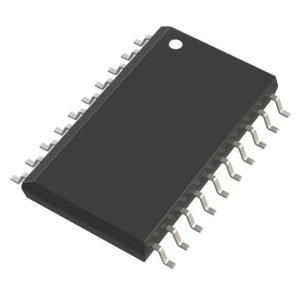
TEA1782T
PFC + LLC combo controller for high-efficiency AC-DC power supplies.
Product Description
The TEA1781T and TEA1782T are designed to cooperate with the TEA1771T primary side controller in a unique converter topology based on the active clamp forward converter. On the secondary side the output voltages are regulated via bidirectional switches. A typical application area of this converter is a power supply for a desktop PC.
The TEA1781T and TEA1782T are secondary control ICs and regulate each output voltage independently of the primary duty cycle and other secondary output voltages. Because of these separated regulations, the system does not show any cross regulation and makes the design of the transformer easier. As each output can also be completely turned off, the system allows for an integrated standby supply. To maximize the efficiency in Standby mode, the duty cycle and operating frequency are minimized in Standby mode. The TEA1781T and TEA1782T have integrated drivers and individual output voltage regulators. In this way the 3.3 V, 5 V, 12 V and 5 V standby outputs of a typical PC power supply are regulated separately giving accurate output voltages and fast transient response.
All requirements according to the Intel ATX specification (V 2.0) are integrated, such as soft start, a PS_ON# connection, a PwrOK signal and all required protections like OverCurrent Protection (OCP) and OverVoltage Protection (OVP). These voltage and current levels are monitored at each output separately. The system also has an OverTemperature Protection (OTP) function. The system fulfills the current and proposed efficiency standards such as 80+ gold, energy star and blue angel. The TEA1781T and TEA1782T are implemented in a high voltage (ABCD) Silicon On Insulator (SOI) process.
Key Features
Designed for ATX PC power supplies
■ Integrated standby supply
■ Enhanced efficiency in Standby mode
■ No cross regulation
■ Accurate output voltage regulation
■ Fast transient response
■ Integrated soft start for all output voltages
■ Flexible transformer design without the need of a post regulator
Overvoltage protection
■ Overcurrent protection
■ Overtemperature protection
■ System failure detection
■ Soft (re)start
■ Low external component count